 Organização Comunista Internacionalista (Esquerda Marxista)
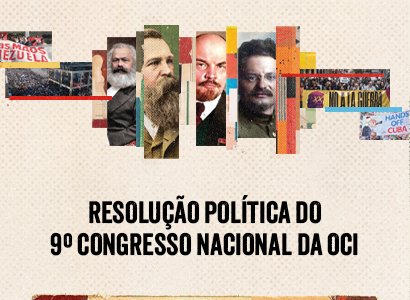

What today constitutes the Internationalist Communist Organization (OCI), which carries in its DNA proletarian internationalism, the struggle for class independence, against petty-bourgeois tendencies in the workers’ movement, against class-collaboration governments such as Popular Fronts and national unity governments, against imperialism and its agents within the organizations recognized by the working class as its own, and which takes pride in its battles as the leadership of the Occupied Factories Movement, in the fight against racism and racialism, in the struggle against identitarianism and postmodern conceptions among youth and in the workers’ movement, was, from 2008 until September 14, 2025, the Brazilian section of the International Marxist Tendency (IMT), now the Revolutionary Communist International (RCI). That period has come to an end. Here we present to the workers’ movement and to the youth the political reasons, since politics commands everything, that culminated in the split carried out by the International Secretariat of the RCI, with the support of a minority faction in Brazil.
This split in Brazil bears historical significance and reflects the new world political situation, marked by the end of the Yalta and Potsdam order and by the deepening of the organic crisis of capital in its imperialist stage, by the growing polarization of the political situation, and by the intensification of the international class struggle. The Central Committee unanimously approved, in March 2025 and later in June 2025 with updates, the political document preparing for our 9th Congress of the OCI, in which we explained:
“This will mean more crises and clashes among the governments of different countries, yet all entangled in the web of international finance capital, which knows no borders and struggles with the continued existence of nation-states and the private ownership of the means of production. This situation will inevitably expand imperialist domination and provoke the reaction of oppressed peoples. The differentiation between dominant and dominated countries, one of the defining traits of the imperialist epoch, will necessarily deepen. And indeed, the entire struggle will rest in the hands of the working class.
The development of the crisis of capital will deepen even further in this situation, leading to the disintegration of the world market and, consequently, to an even greater crisis of the institutions the bourgeoisie itself created during its period of development, as well as of the living conditions of the peoples. This will mean greater polarization between the classes, wars and revolutions, but also, necessarily, political and organizational differentiations within the working class, which, in order to fight, finds itself compelled to confront the official leaders of the organizations the class still recognizes as its own.”
In analyzing the Trump government, a phenomenon that catalyzed the deepening of the organic crisis of capital, we correctly stated that its drive is to reinforce the Bonapartist traits of the U.S. regime:
“These Bonapartist traits emerge in all bourgeois democracies around the world, which can no longer coexist with the democratic liberties wrested by the proletariat through its struggles in the 19th and 20th centuries. They reveal the true skeleton of the bourgeois state, which is, in essence, a gang of armed men with a system of prisons to defend capital. Bourgeois democracy, which calls itself liberal, rocks itself to sleep in the arms of right-wing populisms and in repression against any form of dissent. This is an extremely important feature of the international situation, marked by the accelerated decomposition of the capitalist system in every sphere: economic, political, cultural, artistic, and social.”
These analyses hold even greater accuracy and importance in the current situation, precisely because, in the face of a deep crisis of the capitalist system, the bourgeoisie, incapable of continuing to develop the productive forces it has created, must, in order to prevent the rebellion of those same productive forces, on the one hand, deepen the Bonapartist traits in various bourgeois democracies and, on the other, increase the pressure on the organizations of the working class, bending them toward opportunism or driving them to succumb to all sorts of ideas and methods alien to the working class.
When the bourgeoisie succeeds in bending workers’ organizations toward opportunism, it integrates them into the state apparatus and corrupts their leading layers, just as Lenin explained in Imperialism, the Highest Stage of Capitalism.
When it cannot directly bend the organizations of the workers’ movement, the pressure exerted by the bourgeoisie and the petty bourgeoisie pushes these organizations to adopt ideas alien to the working class: racialism, identitarianism, postmodernism, popular frontism, the cult of new “vanguards,” theoretical eclecticism of every kind, sectarianism, and so on.
These ideas also manifest themselves through loose organizational methods, slander, personal attacks, and even fraud. All of these methods are foreign to revolutionary Bolshevism, which bequeathed to us democratic centralism,the dialectical expression of the political, economic, and theoretical struggle of the working class for its emancipation,ensuring the dialectical unity between freedom of discussion and practical unity of action in the class struggle.
The result of this pressure is theoretical, political, and organizational clashes within proletarian organizations, in which the different wings, expressed through individuals, take the stage within the proletarian organization itself.
The history of workers’ parties and organizations is full of fusions and splits, tendencies and factions which, in the final analysis, are resolved through the class struggle and through revolution itself,the moment when the proletarian masses enter the scene to take control and decide their own fate.
With this understanding, we have fought in a centralized and fraternal way within the IMT/RCI over the past 17 years, so that this international organization could achieve its best possible development, aiming to serve as an embryo for the reconstruction of a true Communist International, of Lenin and Trotsky, with mass influence.
For us, this was our International, and we fought for its development,from the very construction of the Brazilian section itself, through every battle of international solidarity, as well as through contributions, amendments, and alternative documents on theoretical questions, conjunctural analyses, and organizational issues. Without a doubt, we raised numerous important questions for discussion, on which no agreement was reached:
The question of whether productive forces continued to develop after the Second World War. According to the leadership of the RCI, they continue to develop even today (see the resolution of the 2025 World Congress), whereas for us, the productive forces are stagnant and have, in fact, turned into destructive forces. Moreover, for the RCI leadership, the productive forces can grow and develop regionally or by country, since their conception equates the creation of factories, the development of science, technology, and machinery with the development of social productive forces. We, on the other hand, hold that productive forces are a social and historical concept, and therefore not applicable regionally or nationally,and that in the epoch of imperialism, these productive forces even turn into destructive forces.
The opinion that wars are “unnecessary expenditures,” that the war in Ukraine was “unnecessary” (sic!), whereas we maintain that wars are inherent to imperialist capitalism, and militarism is its reserve engine in the face of the organic crisis of capital since the 20th century.
On the question of imperialism: for the RCI leadership, annexations such as that of South Ossetia by Russia or the invasion of Ukraine are considered expressions of imperialism. Our position, however, follows Lenin’s understanding of imperialism,as the domination of finance capital.
On the character of Russia: the RCI leadership at one moment classifies it as a “regional imperialism”, and at another describes it as an “emerging imperialism.”
On the character of China: the RCI leadership regards it as an emerging imperialism which, together with Russian imperialism, disputes world hegemony against U.S. imperialism in a multipolar world where imperialist powers compete among themselves. This forms the core of the RCI leadership’s analysis of the world situation: a conflict between blocs of nations, rather than the class struggle.
On the existence of so-called “regional imperialisms”, such as Brazil, Argentina, Turkey, Pakistan, Iran, etc.,countries that we consider dominated, semi-colonial, and semi-industrialized.
On the question of Palestine: there were constant difficulties in reaching a common formulation on this issue in the resolutions. The resolution of the Palestinian question was always deferred to the victory of the revolution throughout the Middle East,which is not untrue, but completely ignores the political struggle within all of Palestine, that is, the place of transitional demands in Israel, the West Bank, and the Gaza Strip, throughout the whole of Palestine. Thus, we were taken by surprise when a member of the IEC leadership, during the World Congress, declared that there were growing differences regarding our views on Palestine. We then discovered, in a text we had not previously known, that the actual position of Ted Grant and Alan Woods was:
“Nevertheless, Israel now exists as a state, and the clock of history cannot be turned back. Israel is a nation and we cannot call for its abolition. The solution of the Palestinian national problem (which we deal with later) can only be achieved through the establishment of a socialist federation of the Middle east in which Arabs and Israelis can co-exist with their own autonomous homelands and full respect for all national rights.” (‘Marxism and the National Question’, Alan Woods and Ted Grant. Published in February 2000 on the In Defence of Marxism website and republished on October 4, 2015, on the Italian section’s website.)
This position, in fact, amounts to accepting the policy of two states, even if disguised under the impossible idea of a socialist Palestine alongside the Zionist State of Israel. At its core, it represents an adaptation to the UN’s 1947 decision to partition Palestine,an acceptance of the Oslo Accords, despite formally claiming to oppose them, while in practice joining the chorus for “two states,” albeit from a leftist and ultimately unworkable standpoint. This position is subtly reflected in the orientation of the texts produced by the Brazilian breakaway faction.
The OCI reaffirms its position that our main mobilizing slogan for Palestine and for the destruction of the racist Zionist State of Israel is the struggle for a unified Palestine, within a single, secular, and democratic state encompassing the entire historical territory of Palestine , where all its religious, ethnic, and historical communities may coexist as equals. As Marxists know, such a goal can only be achieved as the result of a socialist revolution throughout Palestine and the Arab countries of the region, aiming toward a Socialist Federation of the Middle East , which is our objective.
Undoubtedly, these are major and important disagreements, but they never prevented us from coexisting and acting together within the class struggle. Over the course of 17 years, the international leadership NEVER , NEVER , opposed any analysis or political action taken by the Esquerda Marxista, today the OCI, in Brazil. Not once did it make a single remark about any political or organizational mistake on our part.
We have always published all documents issued by the organs of the International, even when we did not fully agree with them. And up until last year, we voted for texts even when we had significant disagreements, because the core of those texts and their practical conclusions aligned with our own positions. A Marxist does not cut down the tree because it has one or several dead branches.
However, a qualitative change occurred in 2024, following the emergence of a new world situation that was already taking shape , a qualitative leap in the international crisis of capital and its political consequences , combined with the founding of the Revolutionary Communist International, proposed by the IS in February 2024 and formally established in June of that same year, just four months later. This marked a turn toward self-proclamatory impatience and its inevitable consequences.
The Self-Proclamation of the Revolutionary Communist International
As the result of a correct analysis of the polarization of the class struggle and the radicalization of the youth, the IMT launched the campaign “Are you a communist? Then get organized!” at its 2023 World Congress. This campaign gave a tremendous boost to the building of the IMT, yielding a balance of 2,370 additional militants between June 2023 and June 2024, with growth in various countries around the world. However, from June 2024 (the founding conference of the RCI) to June 2025, the balance of growth was only 65 militants.
This advance in organizational construction was taken as the basis for founding the Revolutionary Communist International, amid an atmosphere of enthusiasm in which , even while voting in favor of the proclamation , we raised reservations about the need to ensure that this would not become a self-proclamatory step. Yet self-proclamatory enthusiasm was widespread within the RCI and clouded a sober analysis of what the next step in construction should have been.
The Founding Manifesto of the Revolutionary Communist International pointed out that the phenomenon falsely known as “globalization” had allowed the bourgeoisie to attempt,though only partially,to overcome the limitations of the nation-state through the expansion of world trade, but that this process had reached its limits and was now in retreat:
“Economic nationalism and protectionist measures are now the dominant tendencies – precisely the same trends that turned the recession of the 1930s into the Great Depression. This marks a decisive change in the whole situation. It has inevitably led to an enormous exacerbation of the contradictions between nations and the proliferation of military conflict and protectionism. It is very clearly expressed by the noisy campaign being waged by US imperialism under the banner of ‘America First!’ ‘America First’ means that the rest of the world must be pushed into second, third or fourth position, leading to further contradictions, wars and trade wars.” (Founding Manifesto of the Revolutionary Communist International)
After one year of the RCI’s founding, the conflict among China, Russia, and the United States,already part of the analysis at the time of the RCI’s founding, against which we had presented our disagreement, but which was then situated within the class struggle and presented as a component of the international situation,took center stage in the analysis:
“The world situation is dominated by enormous instability in world relations. This is the result of the struggle for world hegemony between the US, the world’s most powerful imperialist power, which is in relative decline, and China, a younger, more dynamic rising imperialist power.
(…) Now we can see a glimpse of what a ‘multipolar’ world might look like: imperialist powers carving out the world into spheres of influence, bullying countries into submitting to one or another.” (The World Turned Upside Down: A System in Crisis)
The pressure of the bourgeoisie and petty bourgeoisie penetrates the International through theoretical eclecticism, combining elements of Marxist analysis with elements of what is called “geopolitics”,a bourgeois theory that arose in the context of the transformation of competitive capitalism into monopoly capitalism, intended to justify and guide the struggle for colonies, markets, and strategic routes.
It is a fundamentally bourgeois theory, one that centers its analysis on natural conditions,such as territory, position, and resources,rather than on the social structure and relations of production that exist within the world market, that is, the class struggle. It forgets the international domination of finance capital over the world market, as Lenin explained.
This conception was blended with elements of Marxist analysis in order to interpret the new situation and the supposedly “imperialist” role of China, leading to the following assertion:
“China has become a systemic rival of the US on the world scene. This is the real meaning of Trump’s trade war on the country. This is a struggle between two imperialist powers to assert their relative strength on the world market.” (The World Turned Upside Down: A System in Crisis)
As we can see, this analysis inverts what was stated in the Founding Manifesto of the RCI, which identified trade wars not as the result of China’s rise as an imperialist power, but as a product of the limits of “globalization”,that is, the deepening of the capitalist crisis culminating in the tendency toward economic nationalism and protectionism.
The Founding Manifesto of the Revolutionary Communist International said the following about the current situation of the productive forces in the world:
“The present crisis is not a normal cyclical crisis of capitalism. It is an existential crisis, expressed not only in the stagnation of the productive forces, but also in a general crisis of culture, morality, politics and religion.” (Founding Manifesto of the Revolutionary Communist International)
A year later, we see an inversion, where the productive forces are now said to be developing in China:
“The development of productive forces in China is now an established fact. It is pointless to deny this. Nor, objectively speaking, is it a negative development from the standpoint of the world revolution, for it has created a massive working class, one which has become used to a steady increase in its living standards over a protracted period. This is a young, fresh working class, unsaddled by defeats, not bound by reformist organisations.” (The World Turned Upside Down: A System in Crisis)
Moreover, it ignores the fact that the trade war was unleashed against the majority of countries, to a greater or lesser extent, as part of a global offensive against the working class. Impressionism had taken hold within the International, obscuring a correct understanding of the class struggle.
It is important to emphasize that this conception expressed in the Founding Manifesto of the RCI is developed in one of the central theses of the report to the 9th Congress of the OCI, which affirms:
“The development of the crisis of capital will deepen even further in this situation, leading to the disintegration of the world market and, consequently, to an even greater crisis of the institutions that the bourgeoisie itself created during its period of development, and of the living conditions of the peoples. This will mean greater polarization between the classes, wars and revolutions, but also, necessarily, differentiations among the fractions of the ruling classes and political and organizational redefinitions within the working class, which, in order to fight, finds itself increasingly compelled to confront the official leaders of the organizations that the class still recognizes as its own.”
The founding of the RCI also marked a decisive turning point in the political conception of what kind of International and what kind of national organizations should be built. It was no longer a matter of a current, an international tendency of Marxist organizations engaged in education, propaganda, and direct participation in the class struggle, organizing and building while maintaining independence, yet taking into account the mass organizations of the working class and their treacherous apparatuses.
Suddenly, the situation “demanded” and “permitted” the proclamation of a Revolutionary Communist International, whose task was to launch revolutionary communist parties,even if they consisted of only a few hundred members and had almost no roots in the working class. This sectarian conception of self-proclamation, as has already been demonstrated in this short period, also led to opportunism.
The immediate consequences of this new conception of the International were, first and foremost, enormous pressure for the growth of the sections and of the International as a whole. And it was precisely through this opening that opportunist concessions were invited to enter. How could one justify calling oneself a Revolutionary Communist International while transforming small sections into Revolutionary Communist Parties if growth after the proclamation of the RCI was so negligible?
This began to manifest itself as a growing and distressing pressure on the leaders who had promoted this political line,and, conveniently, they began to ignore the penetration of ideas alien to the working class within the International. This would have disastrous consequences, culminating in the split organized by those very same leaders against the OCI, which had never compromised with ideas that questioned Marxism.
Thus, from the moment of the RCI’s proclamation, pressures arose that led various sections to begin searching for shortcuts to growth. Some expanded, others lost militants,including Brazil,but the most significant losses occurred in Sweden and Russia, where a split was led by a historical leader of the section who held anarchist positions.
In an organization that, in 2018, held an international discussion,educating all its sections and producing a document entitled “Marxism and the Struggle Against Ideas Alien to the Working Class,” whose central focus was the fight against identitarian and postmodern ideas among youth and within the working class,adaptations to identitarianism and postmodernism began to appear.
The Mexican section began using gender-neutral language in activity invitations on social media, according to one of its leaders, because it was supposedly the only way to conduct work within the universities.
The U.S. section publicly joined the call for a queer demonstration organized by a bourgeois foundation.
The Italian section took part in the March 8 demonstrations, carrying a banner reading “Revolutionaries Against Patriarchy” and posting on social media that in Italy most fathers are “boss fathers”, directly blaming proletarian men for the exploitation and violence against women , a complete misunderstanding and distortion of what Engels explained in his book The Origin of the Family, Private Property and the State.
And currently, in England , where the International Secretariat is based , the newly founded RCP participates in street demonstrations with its placards, yielding to the chorus that fascism threatens the world (or at least Britain), and raising slogans of the purest petty-bourgeois and reformist essence: “Smash the Fascist Threat” and “Don’t Blame the Boats. Blame the Billionaires!”
Regardless of whether the texts of the leaflets explicitly mention the struggle against capital and for communism, the presentation itself is the political head of the action. This is not a legitimate tactic but an adaptation to identitarianism and postmodernism.
However, there was no rupture over these reasons. We believed that discussion could continue and that these issues could be corrected, and, moreover, that such deviations were not at the core of the debate at the World Congress.
But there is no doubt, as always, that those who begin revising Marxism never stop at the first letters. The minority faction that secretly organized a split over the past two months has just adopted, in its report to the founding congress of the “new Brazilian section of the RCI,” a paragraph that continues this unscrupulous and limitless “search for growth,” which speaks for itself:
“Moreover, this shared plan must be able to engage with the new relationships, languages, and dynamics established by the new generations. The new Brazilian section of the RCI must make itself present where young people are, especially among the youth of the youth, through TikTok, Discord, and other digital forms used by young people. This system of agitation and propaganda must be in tune with the new times and new generations.”
In the case of the British section , the largest of all , the emergence of the slogan “Revolution Against the Billionaires” was explained as follows:
“We adopted bold slogans and statements that firmly placed the blame for the social crisis on the ruling class: Who is responsible for the housing crisis? The landlords. Who is attacking our wages? The billionaires. Who is creating the migration crisis? The imperialists.
By blaming refugees and migrants for all these problems, Robinson, Farage, and Starmer are letting the real criminals,the bankers and bosses,off the hook and dividing the working class. That’s why we put forward the slogan: ‘Blame the billionaires, not the boats.’” (United Kingdom counter-demo: RCP says ‘fight the billionaires, not the boats!’)
This is a policy based on the analysis that the “culprits” are the billionaires, bankers, landlords, etc., rather than the capitalist system itself,engendered by its own contradictions, which compel individual capitalists and, ultimately, the bourgeois class as a whole to act according to its inherent laws of motion. It is a new version of the “struggle against neoliberalism,” rather than against capitalism itself.
This was the section’s response to the far-right demonstration of 100,000 people held in September. As for the official left-wing leaders, Corbyn and Sultana, their stance was to denounce the absence of a revolutionary program and to recall Corbyn’s hesitations and betrayals,without even proposing a united front orientation that could have engaged with the base of 800,000 people who registered with Corbyn and Sultana’s party within four days.
Having just proclaimed a Revolutionary Communist Party (RCP), they do not know how to act in relation to a party that, at the mere call of Corbyn and Sultana, is capable of rallying the masses,and which, according to polls, already commands 15% of the vote in Britain. In their statement, they call on militants and sympathizers to organize within the RCP to arm this new party of Corbyn and Sultana with a revolutionary program. But how do they intend to achieve this as the RCP, addressing a new mass party while remaining outside of it,the New Left Party?
The new, self-proclaimed conception of the International,one that merely “lacks the adherence of the masses”,has led the principal international leaders of the RCI to adopt the idea that an organization striving to reach its first 10,000 members must have complete political, theoretical, and tactical homogeneity. It cannot coexist with differences. The notion that “true unity must be based on principles, which is only possible on the basis of agreement on all central questions” leads, in practice, to a dead end. In other words: the “principles” become the political decisions of the conjuncture,and therefore, if the conjuncture and its central questions change, the principles themselves are also changed.
With such a conception, no party could endure the vertiginous class struggles experienced since the early 20th century. The Bolshevik Party would have had to be divided several times during the revolutionary years,and even during the Third International,up to Lenin himself.
It was through this conception,that the differences we had been raising within the centralized framework of the International were verbalized as “this can’t go on…,” “if this continues, it will end badly…,” and that it was necessary to “refound the OCI against sectarianism and formalism” (statements made by members of the IS and IEC),that a campaign for the split was launched from within the International Secretariat. Shouting “we will never expel anyone for political differences,” they developed the campaign claiming that, with such differences, “coexistence was impossible.”
Public and ongoing attacks accused the Brazilian section and its main leaders of being non-Marxist, metaphysical, scholastic, formalist, and, finally, idealist. These attacks became an almost permanent feature within the international leadership, creating an unbearable situation intended to push the leadership of the OCI into “provoking the split.”
The Petty-Bourgeois Pressure of the RCI Leadership Penetrates the Brazilian Section
These petty-bourgeois ideas penetrated the Brazilian section and found expression in a faction that consolidated at an unprecedented speed in our history. This faction, organized by two leaders who had repeatedly voted for and reaffirmed the Central Committee Report, suddenly emerged claiming a total incompatibility between the CC Report and their new ideas, as well as with the “methods” of the Brazilian leadership.
They produced an alternative document for the 9th Congress of the OCI , a mistaken document , in which they rewrote the history of Brazil by analyzing the foreign policy of each government in relation to either Chinese or U.S. imperialism. They claim that Brazil today is the stage of an inter-imperialist struggle between China and the United States. This is what supposedly justifies an article published on the RCI website entitled “Brazil: confronting American aggression without relying on Chinese imperialism”, which links the June 2013 demonstrations, the Lava Jato operation in 2014, Dilma Rousseff’s impeachment in 2016, and Bolsonaro’s election in 2018 to “the arrival of Chinese capital in Brazil, displacing the previously dominant U.S. financial hegemony and competing with the financial capital of the traditional imperialist countries.”
In its counter-report, the faction presented a revision of the analysis of Brazil’s entire recent period, reframing all events around the argument of how close or distant each government stood from the interests of either Chinese or U.S. imperialism. This represents the application of geopolitics to Brazil through the foreign policy of each administration.
In their alternative document, not a single word was devoted to combating postmodern or identitarian conceptions. On the contrary, as we have already demonstrated, they open the door to them.
The opportunist character of the document was fully revealed in its failure to propose any practical change to the central political line we have been developing , the campaign “Down with Imperialism and Its Wars!” Not a single amendment to its call, no new proposal consistent with the ideas presented in the document.
However, without addressing this issue , neither in their document nor when questioned during the Central Committee discussion , the faction was already adopting an orientation that equated the fight against U.S. imperialism with the fight against China. This can be read on the RCI website, in the article “Brazil: confronting American aggression without relying on Chinese imperialism,” signed by one of the leaders of the breakaway faction, where their current tactical line for Brazil is expressed as follows:
“Against Trump and Xi Jinping, only the working class, acting independently of the bourgeoisie and imperialism, fighting for the abolition of capitalism, can guarantee sovereignty and emancipation.”
Revisionism and the anxiety to rid oneself of “old ideas” always lead to the forgetting of the existence of the masses, of their consciousness, and of how to reach and help them advance , just as we did in the past with Down with the Dictatorship, Direct Elections Now, Out with Collor, and Out with Bolsonaro: always one step ahead, but never detached from the consciousness of the class, helping it move forward toward mobilization and organization, toward revolution.
A banner at a public demonstration today, in the current political situation, reading “Against Trump and Xi Jinping” would sound like “Chinese” to the working class and youth , and would be a source of laughter for the most advanced layers.
The opportunist character is reinforced once again when, in the publication of the new website of the new section, the campaign “Down with Imperialism and Its Wars!” was removed from the proposed political report for the “Refounding Congress” scheduled for November , further evidence that this split was the result of a deliberate operation.
A Qualitative Leap: An Opportunist and Sectarian Policy Leads to the Adoption of Methods Foreign to Bolshevism
These political developments reached an acute point, expressed in the adoption of methods foreign to Bolshevism: the breaking of democratic centralism and the use of slander and personal attacks as a method. All of this was endorsed and defended by the IS, which, supporting every slander and falsehood, refused, during the IEC meeting, to present any proof for its claims, and even decided, as if it were Zinoviev himself, to intervene directly in the functioning of the OCI in defense of the breakaway faction, which had organized a clique in recent months.
The faction within the OCI began to use slanderous accusations against the organization’s leadership, persistently approaching members across the country outside the elected bodies and responsible committees, sending documents to comrades in different cells without the knowledge of the leadership, thereby openly breaking with democratic centralism. Despite all this, the faction received full support from the leadership of the RCI.
On September 13, the International Executive Committee (IEC), in an emergency meeting, approved a resolution that adopted as “truths”, and as the official position of the International, the slanders, spurious methods, and practices alien to the workers’ movement carried out by the faction.
The functioning approved in this resolution resembles that applied by the Pablist International between 1946 and 1953, when Michel Pablo began to exercise an ultracentralism in the Zinovievist style, overriding the elected national leaderships and turning the sections of the Fourth International into mere representatives of the international apparatus.
This is not a minor issue: it is a question of principle for a Bolshevik organization. Up to that point, even with political disagreements, we had always presented our positions within the centralized framework of the RCI. No theoretical, political, or tactical discussion that we presented within the International, and since the emergence of the faction in Brazil, was, in our view, grounds for any rupture.
Lenin explained:
“As a current of political thought and as a political party, Bolshevism has existed since 1903. Only the history of Bolshevism during the entire period of its existence can satisfactorily explain why it has been able to build up and maintain, under most difficult conditions, the iron discipline needed for the victory of the proletariat.
The first questions to arise are: how is the discipline of the proletariat’s revolutionary party maintained? How is it tested? How is it reinforced? First, by the class-consciousness of the proletarian vanguard and by its devotion to the revolution, by its tenacity, self-sacrifice and heroism. Second, by its ability to link up, maintain the closest contact, and,if you wish,merge, in certain measure, with the broadest masses of the working people,primarily with the proletariat, but also with the non-proletarian masses of working people. Third, by the correctness of the political leadership exercised by this vanguard, by the correctness of its political strategy and tactics, provided the broad masses have seen, from their own experience, that they are correct. Without these conditions, discipline in a revolutionary party really capable of being the party of the advanced class, whose mission it is to overthrow the bourgeoisie and transform the whole of society, cannot be achieved. Without these conditions, all attempts to establish discipline inevitably fall flat and end up in phrasemongering and clowning. On the other hand, these conditions cannot emerge at once. They are created only by prolonged effort and hard-won experience. Their creation is facilitated by a correct revolutionary theory, which, in its turn, is not a dogma, but assumes final shape only in close connection with the practical activity of a truly mass and truly revolutionary movement.” (“Left-Wing” Communism: an Infantile Disorder)
For the majority of the Brazilian Central Committee, it became impossible to submit to the slanders, defamations, and the kind of bureaucratic centralism imposed by the resolution adopted by the International Executive Committee (IEC).
When the majority of the Brazilian CC refused to accept the slanders and methods that this resolution sought to impose as truths, characterizing it as unacceptable, it was precisely combating, within that IEC resolution, the absence of the very qualities that Lenin described as the defining features of Bolshevism: those that made it possible to create and maintain, even under the most difficult conditions, the iron discipline necessary for the victory of the proletariat.
The breaking of democratic centralism and the use of slander (methods employed by the faction in Brazil and incorporated by the RCI leadership), along with the direct intervention into the functioning of sections to favor specific positions, are, within a Bolshevik organization, unacceptable. They demonstrate the point to which the theoretical and political conceptions we had been struggling against, within the framework of the RCI’s democratic centralism, have now degenerated.
One of the inventions that the IS and the Brazilian faction have used to conceal their methods is the claim that there was a supposed prohibition on political discussion between militants from different bodies of the OCI. This is false.
All militants are free to communicate with one another, without any kind of sanction. What is not permitted in any Bolshevik statute is the organization of a factional political struggle conducted outside the elected bodies, and against those very bodies,that is, attempting to recruit militants against the political line approved by the Central Committee or by Congress. Such functioning would be pure anarchy, alien to the revolutionary workers’ movement, which, in its struggle against the bourgeoisie, relies solely on its organization.
This qualitative leap completely transformed the international organization that we had fought to build over the past 17 years. It is clear proof that mistaken theoretical conceptions and political analyses produce methods alien to the working class. What we witnessed in this split process was a dialectical symbiosis between form and content: the development of analyses that gradually abandon Marxism, a political practice that yields to opportunism and sectarianism, and the consequent adoption of methods foreign to Bolshevism.
We made several appeals to reach an agreement on principles based on the immediate cessation of the violation of democratic centralism and the use of slander as a method.
These appeals were made because the majority of the Central Committee expressed its greatest interest in continuing the theoretical and political debate that had been developing in the first months of preparation for our 9th OCI Congress, advancing the analysis on China and all other issues, so that our Congress could adopt the most just and correct political line. More generally, it is also in the interest of the working class that its organizations preserve unity and common action in the class struggle.
With the methods imposed by this IEC resolution, the free and democratic political and theoretical discussion of ideas was rendered impossible, because it came to be accepted that anything goes in order to defend one’s positions. This was deemed unacceptable precisely because it prevented our differences from being discussed in a healthy, democratic manner, while respecting democratic centralism.
In response to that resolution, the majority of the Central Committee approved a resolution calling for an Extraordinary Congress in October, the political basis of which was the break with the RCI. This resolution, approved by the CC majority, was submitted to all militants for a final decision at an Extraordinary Congress, in which both sides could defend their positions democratically and could even, in principle, defeat the proposal for the OCI’s withdrawal as the Brazilian section of the RCI.
However, at the end of the vote, Jordi Martorell, acting as a representative of the IS, declared: “This body is no longer the Central Committee of a section of the RCI,” and left the meeting, followed by Fred Weston of the International Secretariat. All CC members (full, invited, and alternate) belonging to the faction left immediately afterward, organizing, that same evening, a meeting of the faction’s members, which convened an emergency RCI conference in Brazil, and, in turn, called for a “Refounding Congress” of the section.
We therefore conclude that this was a rupture organized by the International Secretariat and its factional representation in Brazil, an act that, in its final form, broke entirely with democratic centralism.
The Internationalist Communist Organization has already demonstrated countless times that it possesses a conscious proletarian vanguard, animated by a spirit of sacrifice and heroism. It has already shown that, through the proletarian united front, it was able to connect with the broad masses of workers and non-workers alike, confirming the political correctness of its historical struggle as the leadership of the Occupied Factories Movement, and through the audacity and political clarity of the “Out with Bolsonaro!” line, the first organization to raise that slogan, which the masses embraced throughout Brazil.
However, in the present national and international crisis, the international leadership of the RCI and its factional representation in Brazil have openly decided to break with democratic centralism. This represents a decisive step, not only a rupture with democratic centralism itself, but a transformation of the International as a whole into another kind of organization, incapable of responding to the immense challenges posed by the deep crisis of capitalism and the class struggle, for it has severed the link that connected it to the workers’ movement, a link embodied by the OCI, through its history, its cadres, and the discussions we carried out when we were still its section.
The Continuity of the OCI and the Intransigent Defense of Bolshevism and Proletarian Internationalism
The history of the international workers’ movement has known many splits, fusions, and theoretical, political, and organizational debates. It is impossible to build a cadre organization, one composed of militants theoretically grounded in Marxism and tempered in the class struggle, capable of achieving mass influence, if one begins from the idea that everyone must think alike and that there will be homogeneity on all central questions.
On the contrary, differences will always exist, and knowing how to handle them is fundamental to guaranteeing unity. Here, what is at stake is the importance of method.
Throughout its history, the workers’ movement has known various conceptions for organizing its debates and its unity. The highest expression of these conceptions, the one that led the proletariat to victory, was the Bolshevik conception of party organization: democratic centralism.
Lenin explained, in his assessment of the 1903 split between the Bolsheviks and the Mensheviks:
“As a matter of fact, the entire position of the opportunists in organisational questions already began to be revealed in the controversy over Paragraph 1: their advocacy of a diffuse, not strongly welded, Party organisation; their hostility to the idea (the “bureaucratic” idea) of building the Party from the top downwards, starting from the Party Congress and the bodies set up by it; their tendency to proceed from the bottom upwards, allowing every professor, every high school student and “every striker” to declare himself a member of the Party; their hostility to the “formalism” which demands that a Party member should belong to one of the organisations recognised by the Party; their leaning towards the mentality of the bourgeois intellectual, who is only prepared to “accept organisational relations platonically”; their penchant for opportunist profundity and for anarchistic phrases; their tendency towards autonomism as against centralism,in a word, all that is now blossoming so luxuriantly in the new Iskra, and is helping more and more to reveal fully and graphically the initial error.” (One Step Forward, Two Steps Back)
What we witnessed throughout this entire process was, on the one hand, a minority hostile to democratic centralism in relation to the majority of the national leadership, and, on the other hand, an international leadership that began to apply an ultracentralism of a Zinovievist or Pablist type, which, in practice, removes the elected national leaderships, transforming them into mere transmission belts for the decisions of the international leadership on any issue.
From below, there was pressure for the dissolution of the organizational bodies through WhatsApp conversations and undemocratic debates among everyone and anyone, outside the proper structures, accompanied by the use of slander, deceit, and the insubordination of the minority against the majority, all in order to reinforce their positions.
From above, there was an ultracentralizing pressure aimed at subordinating the national leadership, undermining its authority, discrediting its actions, preventing the sanctioning of disruptive practices, and weakening its political and theoretical positions through theoretical disparagement and personal attacks.
No democratic debate of our differences could be conducted under such conditions, and this is no small matter. Without being able to exercise its right as a majority, an organization cannot move forward: it regresses and becomes paralyzed.
Moreover, among revolutionaries, only the truth. The deliberate use of slander as a method, with the goal of disqualifying and ridiculing the positions of the leadership, are base tactics, but ones that have concrete roots.
“When the curve of historical development rises, public thinking becomes more penetrating, braver and more ingenious. It grasps facts on the wing, and on the wing links them with the thread of generalization… But when the political curve indicates a drop, public thinking succumbs to stupidity. The priceless gift of political generalization vanishes somewhere without leaving even a trace. Stupidity grows in insolence, and, baring its teeth, heaps insulting mockery on every attempt at a serious generalization. Feeling that it is in command of the field, it begins to resort to its own means. One of its most important means is slander.” (My Life, Leon Trotsky)
This is precisely what we are witnessing in the present split: a general opinion overtaken by foolishness, one that scorns the Bolshevik method of disagreeing while maintaining unity at the same time; that despises generalizations, demanding immediate answers to its questions and, when not satisfied, throws a kind of political tantrum, flailing about the room.
A world party of the working class, a world army of the proletariat, requires iron discipline precisely because people think differently all the time. It is perfectly natural that differing opinions should emerge and crystallize into minorities, tendencies, and factions, yet still remain within the framework of a single organization.
The use of sanctions against violations of method is not an abuse of leadership, but the proper application of the statutes to correct deviations that wound the necessary unity of the party.
If the RCI believed that we no longer agreed on the fundamental questions and that this undermined the principle of our unity, it should have proposed our expulsion, just as Lenin expelled Bogdanov for his idealist philosophical conceptions. But it did not wish to bear that burden in its own history. Instead, it chose to support every kind of method employed by a faction to impose its political opinions.
The application of the 21 Conditions approved at the Second Congress of the Communist International educated the new Communist Parties in a new conception of the party and of the International, above all, a political one, but one that was necessarily based on democratic centralism:
“12th – The parties belonging to the Communist International must be built on the basis of the principle of democratic centralism. In the present epoch of acute civil war, the Communist Party can fulfill its duty only if it is organized in the most centralized way possible, if iron discipline prevails within it, and if the Party center, sustained by the confidence of the Party members, is endowed with the fullest rights and authority, as well as the most extensive powers.
(…)
16th – All decisions of the Congresses of the Communist International and of its Executive Committee are binding for all parties belonging to the Communist International. The Communist International, operating under conditions of acute civil war, must be built in a far more centralized manner than the Second International. In this process, the Communist International and its Executive Committee must, of course, in all their activity, take into account the different conditions under which the individual parties have to struggle and work, and make binding decisions only in those cases where such decisions are possible.”
Without this, the RCI itself turns into another kind of organization, one that allows concessions to opportunism and sectarianism within its ranks, and that incorporates Menshevik and anarchist methods into its functioning. Such an organization will be incapable of becoming a true proletarian army of the world revolution.
The Internationalist Communist Organization has both a national and an international history. It will continue its struggle for the reconstruction of the Communist International of Lenin and Trotsky, on the basis of the Communist Manifesto, the mass experience of the Second International, the Zimmerwald Conference, the October Revolution, the first four congresses of the Communist International, the Fourth International and its Transitional Program, as well as Leon Trotsky’s struggle to build a true International worthy of that name.
Such an International can only be built upon the Marxist program, even if the precise means and forms through which it will rise as a world party of the socialist revolution are not yet known, in this epoch of wars and revolutions, of resistance and struggle, of the reorganization of the workers’ movement along a new revolutionary axis.
It is with this perspective that, in this epoch of reactionary wars, we fight to regroup all those who, in practice, have truly broken with the bourgeoisie and capital. There is a historical and urgent necessity for the construction of a Communist International Current, in which the OCI will take its place. This effort recalls the Zimmerwald Conference and the struggle for the reconstruction of the International of Lenin and Trotsky.
This Current must be the thread of continuity in the struggle against imperialism and its wars, against opportunism and sectarianism, cemented in the best traditions of revolutionary Marxism, and it must become the instrument of the working class to sweep away the regime of private property over the means of production, opening the road to socialism.
Through this perspective, the OCI reaffirms its commitment to Bolshevik methods and to proletarian internationalism.
Communist greetings,
- Long live the international working class!
- Long live communism throughout the world!
- Long live Bolshevism and the world proletarian revolution!
September 28, 2025
Central Committee of the Internationalist Communist Organization (OCI)